


The Rules of Poker
The rules of poker define how a hand is played and won. A hand is won in one of two ways: by holding the highest-ranked hand at showdown, or by making the last uncalled bet, which wins the pot without a showdown. This page will focus on Texas Hold'em.
Poker uses a hierarchy of ten hand categories, ranked from strongest to weakest: royal flush, straight flush, four of a kind, full house, flush, straight, three of a kind, two pair, one pair and high card. Full definitions, odds and what beats what are covered on the poker hand rankings page.
How a Hand of Poker Plays Out
A hand of poker follows a similar sequence in every game.
- The blinds. Forced bets that are posted before the deal, they start building the pot.
- The deal. Each player is dealt their starting cards. In Texas Hold'em, that is two private hole cards.
- The betting rounds. Play moves clockwise through up to four rounds: pre-flop, the flop, the turn and the river, with community cards dealt along the way.
- The showdown. If two or more players remain after the betting concludes on the river, the hands are revealed and the highest-ranked hand wins.
A hand can also end if every other player folds, and the last remaining player wins the pot.
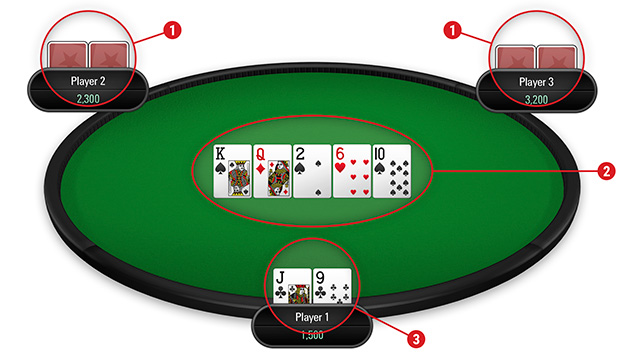
Example of a Texas Hold'em hand after all the cards have been dealt. Each player can use any combination of their two hole cards and the five community cards to make the best five-card hand. In this example, Player 1 combines both hole cards with three of the community cards to make a straight.
- Opponents' hole cards
- Community cards
- Player 1's hole cards
Blinds and Antes
Blinds and antes are forced bets posted before any cards are dealt, used to start the pot and initiate action.
- The small blind is a forced bet posted by the player immediately left of the dealer button, usually half the big blind.
- The big blind is a forced bet posted by the player two seats left of the button.
- An ante is a small, forced bet posted by every player, used in particular games and during late tournament stages to increase each pot.
- Blinds and antes gradually increase in tournaments but remain fixed in cash games.
- A straddle is an optional extra blind posted by the player to the left of the big blind before the deal, to raise the stakes. It is seen more during live cash games, and not commonly available online.
The Betting Rounds
Each hand is broken up into different betting rounds, where the action moves round the table as players act in turn. Variants that have community cards, like Texas Hold'em and Omaha, share the same four rounds:
- Pre-flop. The first round, after hole cards are dealt and before any community cards.
- The flop. The first three community cards. The second round of betting starts after the flop is dealt.
- The turn. The fourth community card. It initiates the third round of betting.
- The river. The fifth community card is dealt which leads to the final round of betting.
A betting round ends when all active players have matched the highest bet, or when all but one player has folded. If everyone checks, the round also ends. Play then moves to the next betting round or to showdown after the river.
Poker Actions
A poker action is the choice a player makes when it is their turn to act.
- Check. To decline to bet while staying in the hand, possible only when no bet has been made in the current betting round.
- Bet. To put the first chips into the pot in a betting round where no bet has yet been made.
- Call. To match the current active bet in the round.
- Raise. To increase the size of the active bet.
- Re-raise. To raise again after another player has already raised in the same round.
- Fold. To give up the hand, forfeiting any claim to the pot.
- All-in. To commit all remaining chips into the pot.
- Muck. To discard a hand face down without revealing the cards, usually at showdown when it cannot win.
The Dealer Button
The dealer button is a marker showing the nominal dealer for a hand, and it dictates the order of action.
The button moves one player clockwise each hand, so the blinds move too. The small blind is immediately to the left of the button, the big blind is two seats to the left of the button. On post-flop betting rounds, the active player immediately to the left of the button acts first.
Betting Limits
Betting limits in poker are the rules that determine how much a player can bet or raise. The main limits are:
- No limit. A player can bet or raise up to their full stack.
- Pot limit. A player can bet or raise up to the current size of the pot.
- Fixed limit. A player can bet or raise only by a predetermined amount.
Table Stakes and All-in
Table stakes is the rule that only the chips in play at the start of a hand can be used during it. A player cannot add chips mid-hand or wager beyond their stack. The movie image of betting a watch or a car to stay in is for dramatic effect, and not how poker is ordinarily played.
A player who does not have enough chips to match a bet is not forced to forfeit their hand but can declare themselves all-in, staying eligible for the part of the pot their chips cover. Those chips form the main pot; further betting between other players goes into a side pot that the all-in player cannot win.
The Pot
The pot is the total amount of chips committed by all players in a hand. The winner of the hand is awarded the pot.
- The main pot contains the chips every remaining player has matched.
- A side pot forms when a player is all-in and others keep betting; only contributors to the side pot can win it.
- A split pot occurs when players have tied hands at showdown and the pot is divided equally.
- Dead money refers to chips that were contributed to the pot by players that have since folded.
The Showdown
The showdown is when remaining hands are revealed and the winner is declared, after the final bet or raise has been called, or if it gets checked down, on the river.
The highest-ranked hand wins. Tied hands split the pot. The full ranking order and details of what beats what are covered on the poker hand rankings page.
Misdeals, House Rules and Variant Differences
A misdeal occurs when cards are dealt incorrectly and the hand must be dealt again, such as when a card is exposed or cards are miscounted. This occasionally occurs during live poker but is not possible in online poker.
House rules are the specific rules set by a poker room or casino that govern how games are played. These are applied automatically during online play.
A lot of the core rules of poker are shared across variants, but some details can differ. For example, lowball games award the pot to the lowest hand rather than the highest hand, which is the rule in games like Texas Hold'em. For details of how the rules differ for each game, visit the individual variant's rules page.
Frequently Asked Questions
The basic rules of poker are that each player is dealt cards and takes their turn to act, they can check, bet, call, raise or fold depending on the situation. In Texas Hold'em, players combine their hole cards with the community cards to create the best five-card hand available. The best hand at showdown, or the last remaining player when everyone else has folded, wins the pot.
There are two ways to win a hand of poker. At showdown, where the player with the highest-ranked hand is awarded the pot. A hand can also be won by making the last uncalled bet, which wins the pot without a showdown because every other player has folded.
Texas Hold'em and Omaha have four betting rounds: pre-flop, before any community cards; after the flop (the first three community cards), after the turn (the fourth community card), and after the river (the final community card).
These are four core poker actions. To check is to decline to bet in an unopened pot while keeping the hand. To call is to match the highest current bet. To raise is to increase the current bet. To fold is to forfeit the hand and any claim to the pot.
The difference is the maximum bet that is allowed. In no limit poker, a player can bet or raise up to their full stack. In pot limit poker, only up to the current size of the pot is allowed.
All-in means a player has committed every chip they have into the pot. Under the table-stakes rule, a player who cannot match a bet is declared all-in, staying eligible for the part of the pot their chips cover. Further betting between other players forms a separate side pot.